Report on garden visit of Friday 13th March 2026
Dr Frances Howard’s garden in Bere Alston
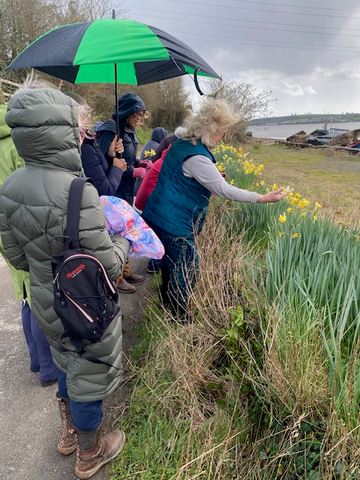
I had attended Frances’ talk on historic daffodils to the Whitecross and District Gardening Club last September and took her up on her offer to bring a group to visit her garden and walk along the lanes bordering the river Tamar to spot many varieties of historic (and more modern) varieties of daffodils.
The weather forecast was not promising so Frances and I agreed that the visit would start with lunch at 12.00pm at the Yard Café Weir Quay where she would give her talk in the comfort of a warm room. Weather allowing, we would then see the daffodils in situ.
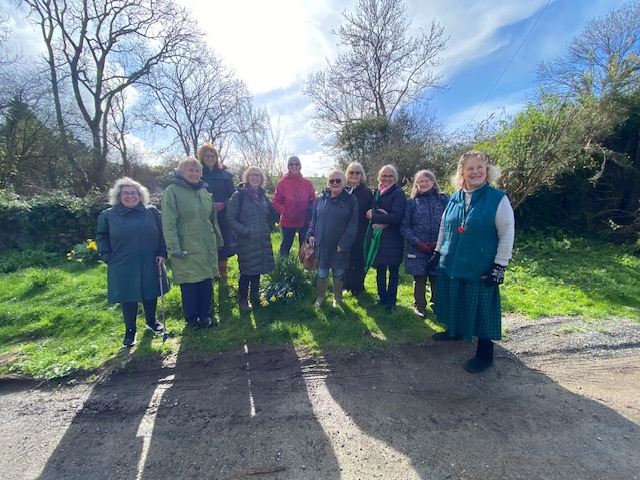
What a fantastic day we had! Eight-members of the u3a group along with 2 friends and members of the Whitecross and District Gardening Club made their way to Weir Quay and had a lovely lunch cooked and served by Christine whose homemade ice-creams are truly delicious!
Frances’ interest in daffodils started 20 years ago when she moved down to Weir Cottage and was given a several bulbs by Lady Boyd who lived in Ince Castle. Her knowledge of the historical daffodils, especially those of the Tamar Valley hedges is second to none. Frances’ talk was very informative and entertaining and there is no way that I can transmit all her knowledge in this report!
Tamar daffodils, as they were so early were sent to Covent Garden, London from 1865 via the river and rail. The railway came through Bere Alston in 1980, so the trade expanded rapidly.
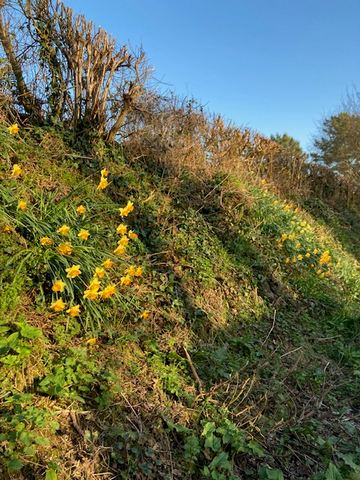
In the 2nd World War, the daffodils had to be replaced by vegetables, so were lifted and thrown into the hedgerows where the grow today.
The historical daffodils in the Tamar Valley hedges are:
Big yellow trumpets: Maximus superbus, King Alfred and Emperor
Frances had invited us to bring daffodils from home if we wanted her help to identify them. I was delighted to hear that I indeed had a clump of “Maximus superbus” in my garden in Penpol (The bungalow was built on the site of an orchard), a variety growing in England before 1576 so seen by Sir Frances Drake (The variety, not mine!).
Medium yellow trumpets: Princeps, Sir Watkin and Lent Lilly
There is a house in Penpoll with a field and orchard covered in “Lent Lilly”, a spectacular sight this time of the year. The hedges bordering the field and orchard are also full of those little native daffodils which grew wild before 1570. This was the “host of golden daffodils” that Wordsworth wrote about.
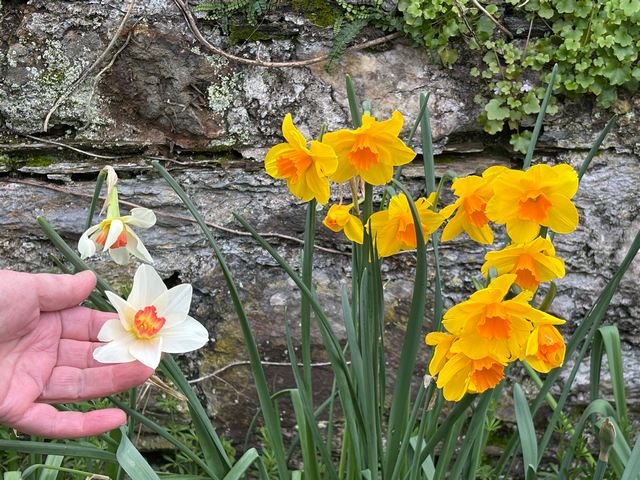
Bi-colours: Empress, Fortune and Bath’s Flame
Post 1st World War varieties like Fortune have thick overlapping petals whereas pre 1st World War varieties have thin and twisted petals. This cascade of “Fortune” can be seen outside the Boatyard on Weir Quay.
Doubles: Van Sion; Eggs and Yolks and Tamar Double White
“Tamar Double White” was found in Clamoak Farm hedge by Septimus Jackson in the 1880s. It is a very strong scented and long vase life variety so sent up to London in special blue tissue lined boxes. It is getting very rare. To grow, it needs to be planted very deep. It flowers very late, in May.
Whites: Ice Lollies, Actaea and Pheasants Eye.
“Pheasants Eye” dates from pre 1900 and its snow-white petals are swept back. It is the father of most flat white narcissi with reflexed petals.
We are thinking of planning a visit to Frances' garden in the Autumn as her garden is full of colours then.